
Bu sayfa henüz sizin dilinizde mevcut değil. Varsayılan dil gösteriliyor.
Why Expensive Business Software Isn't Always the Best Choice
- Yayımlandı:
- Admin
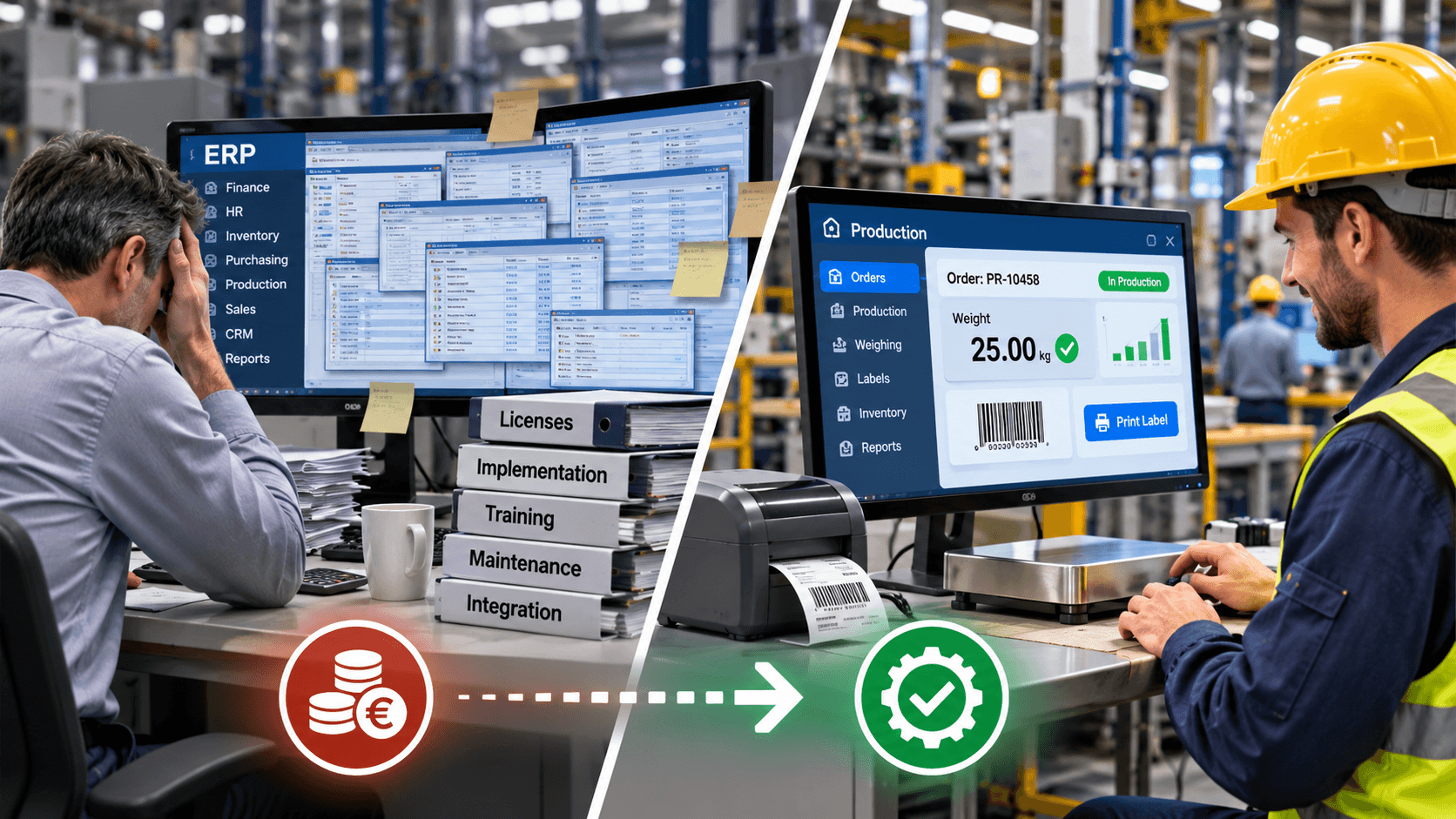
Why Expensive Business Software Isn't Always the Best Choice: The Hidden Value of Custom Software
Choosing the right software for your business isn't about buying the most expensive solution. It's about finding the one that actually solves your problems.
Every year, businesses invest significant amounts of money in enterprise software, ERP systems, production management platforms, and other digital solutions. Many of these products promise improved efficiency, better productivity, and complete control over business operations.
But here's an important question:
Are you paying for the software your business actually needs, or for hundreds of features you'll never use?
For many manufacturers, warehouses, and small and medium-sized enterprises (SMEs), custom software development may offer a more practical, flexible, and potentially more affordable alternative.
Let's explore why.
1. The Hidden Costs of Expensive Business Software
When evaluating commercial software, businesses often focus on the initial purchase price or monthly subscription.
However, the real cost of software goes far beyond the advertised price.
Consider a manufacturing company purchasing a comprehensive ERP system. The software may include dozens of modules covering finance, human resources, inventory, purchasing, production, sales, and customer relationships.
But what if the company only needs production tracking, barcode management, and inventory control?
It may still end up paying for features that provide little or no value to its operations.
Other expenses can include:
- Licensing fees: Recurring payments based on users, devices, or modules.
- Implementation costs: Installation, configuration, and integration with existing systems.
- Employee training: Time and money spent teaching staff to navigate complicated interfaces.
- Customization fees: Additional charges for adapting standard functionality.
- Maintenance and upgrades: Ongoing expenses that may increase over time.
- Integration costs: Connecting the software to machines, databases, barcode scanners, weighing scales, or other business applications.
A system that initially appears affordable can become a substantial long-term investment.
The important metric is not simply the purchase price. It is the Total Cost of Ownership (TCO) over the software's useful lifetime.
2. Your Business Is Unique. Why Should Your Software Be Generic?
Every business has its own workflows, challenges, and operational requirements.
Two factories producing similar products may use completely different production processes.
One manufacturer may need to track raw materials through several production stages. Another may require accurate weighing, barcode verification, and automatic label printing.
A third company might simply need to connect its existing database to production equipment and generate reliable reports.
Standard commercial software is designed to serve a broad market. That makes it convenient for many businesses, but it also means individual companies may need to adapt their processes to fit the software.
Custom software takes the opposite approach: the software is designed around the business.
Instead of changing the way employees work to accommodate a complicated application, a tailored solution can support the company's existing processes and improve them where necessary.
This approach can lead to:
- More intuitive workflows.
- Less unnecessary data entry.
- Faster access to important information.
- Better integration with existing equipment.
- Reduced employee training requirements.
- Greater flexibility as business needs evolve.
The goal isn't to create more software. It's to create software that makes work easier.
3. Custom Software Can Be More Affordable Than You Think
There is a common misconception that custom software development is only suitable for large corporations with enormous IT budgets.
In reality, a custom application doesn't always need to be a massive project.
Sometimes, a relatively small software solution can eliminate an expensive operational problem.
A Practical Manufacturing Example
Imagine a factory that needs to:
- Receive production orders.
- Record product weights from digital scales.
- Generate and print barcode labels.
- Store production information in a database.
- Produce daily and monthly reports.
The company could purchase a comprehensive manufacturing management platform with numerous modules, advanced dashboards, and extensive configuration options.
Alternatively, it could commission a custom application designed specifically for these five tasks.
The second solution might be significantly simpler to implement, easier for employees to use, and less expensive to maintain.
It could also integrate directly with existing weighing equipment, barcode printers, and databases.
Of course, the final cost depends on the project's complexity, security requirements, integrations, and maintenance needs.
But the key principle remains:
Why pay for a hundred features when your business only needs ten?
4. A Cost Comparison: Commercial vs. Custom Software
To understand the financial difference, consider a hypothetical small manufacturing business evaluating two approaches.
| Cost Category | Commercial Software | Custom Software |
|---|---|---|
| Initial implementation | €5,000 | €8,000 |
| Annual licensing | €4,800 | €0 |
| Annual maintenance and support | €1,200 | €1,500 |
| Additional integrations | €3,000 | €1,000 |
| Estimated 3-year total | €26,000 | €13,500 |
These figures are illustrative assumptions, not actual vendor quotations. They assume one-time integration costs, stable annual fees, and no major new development requirements. Hosting, training, and other variable expenses are excluded.
In this example, the custom solution has a higher initial development cost but a substantially lower three-year total.
The estimated difference is €12,500 over three years.
This doesn't mean custom software is always cheaper. Large, complex custom systems can require significant development, security, testing, hosting, and ongoing support budgets.
However, for businesses with clearly defined requirements, a focused custom solution can sometimes provide better value than a much larger commercial platform.
5. Integration With Existing Machines and Systems
One of the biggest challenges in manufacturing and industrial environments is connecting different technologies.
A factory may already use:
- Digital weighing scales.
- Barcode scanners and label printers.
- PLCs and industrial controllers.
- SQL databases.
- Legacy Windows applications.
- Production machines with serial or network interfaces.
Replacing these systems simply to accommodate a new software platform can be expensive and disruptive.
Custom software can often act as a bridge between existing technologies.
For example, a tailored application might read measurements from a digital scale, validate the information against a production order, save the results to a database, and automatically print a barcode label.
All of this can happen within a single workflow, without requiring employees to manually transfer information between different applications.
This is particularly valuable for businesses that depend on specialized equipment or established production processes.
At Rose Etiket, we focus on developing practical software solutions that can combine business applications, databases, automation, and hardware integration.
Our approach is based on understanding how a business actually operates before deciding what technology it needs.
6. Better Software Doesn't Have to Be More Complicated
More features do not automatically mean better software.
In many workplaces, employees only need to perform a limited number of tasks throughout the day.
A production operator may need to select an order, record a measurement, print a label, and confirm completion.
If these simple actions require navigating through numerous menus and unnecessary screens, the software may be creating additional work rather than reducing it.
A well-designed custom application can provide exactly the interface each employee needs.
For example:
- Production operators see production-related functions.
- Warehouse employees access inventory and stock movements.
- Supervisors monitor performance and production status.
- Managers view reports and business indicators.
- Administrators manage users, permissions, and system settings.
This role-based approach can improve usability, reduce avoidable mistakes, and help employees complete tasks more efficiently.
The best business software is not necessarily the software with the most features. It is the software that helps people do their jobs effectively.
7. Start Small and Expand When Your Business Grows
Another advantage of custom software is the ability to develop it in stages.
Instead of implementing a large system all at once, businesses can begin with the functions that provide the greatest immediate value.
For example:
Phase 1 — Core Operations
Develop essential functionality such as production order management, data entry, and basic reporting.
Phase 2 — Automation
Integrate barcode scanners, weighing scales, label printers, and other equipment.
Phase 3 — Advanced Management
Introduce dashboards, performance indicators, inventory tracking, and more detailed reporting.
Phase 4 — Intelligent Features
Where there is a clear business case, introduce forecasting, automated alerts, AI-assisted analysis, or other advanced capabilities.
This phased approach can help companies control their budgets, validate requirements, and reduce the risk of investing heavily in features that may never be needed.
It also creates opportunities to improve the software based on feedback from the people who use it every day.
8. When Is Off-the-Shelf Software the Better Choice?
Custom development isn't always the right answer.
Commercial software can be an excellent option when a business needs standard functionality that is already well supported by established products.
For example, accounting, payroll, email, and common office productivity tools often benefit from mature commercial solutions.
Off-the-shelf software may also be preferable when:
- The business needs an immediate solution.
- Requirements closely match standard industry processes.
- Regulatory compliance is already supported by an established product.
- A large ecosystem of integrations and support providers is important.
- The company doesn't want to manage a custom development project.
In some situations, the best approach is a combination of both.
A company might use commercial accounting software while developing a custom production management application that integrates with it.
The objective should never be to replace existing software simply because it is commercial.
The objective is to choose the most effective and sustainable solution for each business requirement.
9. Five Questions to Ask Before Buying Expensive Business Software
Before committing to a major software investment, business owners and managers should ask themselves:
1. Which problems are we actually trying to solve?
Identify the operational problems before evaluating software features.
2. How many features will our employees realistically use?
Avoid paying for unnecessary complexity unless those capabilities have a clear future purpose.
3. Can the software integrate with our existing equipment and databases?
Consider integration costs, technical limitations, and the potential disruption of replacing existing systems.
4. What will the software cost over the next three to five years?
Include licensing, maintenance, hosting, training, upgrades, integrations, and support.
5. Would a smaller custom solution deliver the same or better results?
Request an independent technical assessment or compare a custom development proposal with commercial alternatives.
These questions can help turn software purchasing into a more informed business decision.
10. How Rose Etiket Helps Businesses Build Software That Fits
At Rose Etiket, we believe technology should solve real business problems, not create unnecessary complexity.
We develop custom software, digital platforms, and practical automation solutions for businesses that need technology adapted to their operations.
Our areas of focus include:
- Custom Business Software: Applications designed around specific business processes and operational requirements.
- Production Management Solutions: Software for manufacturing workflows, production data, and operational reporting.
- Barcode and Labeling Systems: Solutions for barcode generation, label design, printing, and product identification.
- Hardware and Database Integration: Connecting applications with industrial equipment, weighing systems, and existing databases.
- Web Applications and Digital Platforms: Tailored solutions for internal operations, customer communication, and business management.
- Automation and Intelligent Solutions: Reducing repetitive work through integrated systems and appropriate automation technologies.
We don't believe every business needs a massive ERP implementation or an expensive software package.
Sometimes, the right solution is a carefully designed application that performs a few important tasks exceptionally well.
And sometimes, the right solution is to improve or integrate the software a company already owns.
Our goal is to help businesses make practical technology decisions based on their real needs, budgets, and long-term objectives.
Conclusion: Invest in Solutions, Not Unnecessary Features
Expensive software is not necessarily bad software.
Many commercial platforms offer powerful functionality, extensive support, and proven reliability.
But price, popularity, and the number of available features should never be the only factors in a software purchasing decision.
For manufacturers, warehouses, and growing businesses, a tailored application may offer a simpler interface, better integration, lower long-term costs, and greater control over essential operations.
The most important question isn't:
"Which software has the most features?"
It's:
"Which software will help our business work better?"
Before investing thousands of euros in another complicated software package, consider whether a smaller, purpose-built solution could achieve the same results — or even better ones.
Looking for Software That Actually Fits Your Business?
Whether you need a production management system, a barcode and labeling solution, database integration, or a completely custom business application, Rose Etiket can help you explore the possibilities.
Tell us about your business challenge. Let's find the right solution before you invest in the wrong software.
Visit roseetiket.nl to learn more about our software development services and digital solutions.